
ENGLISH VERSION
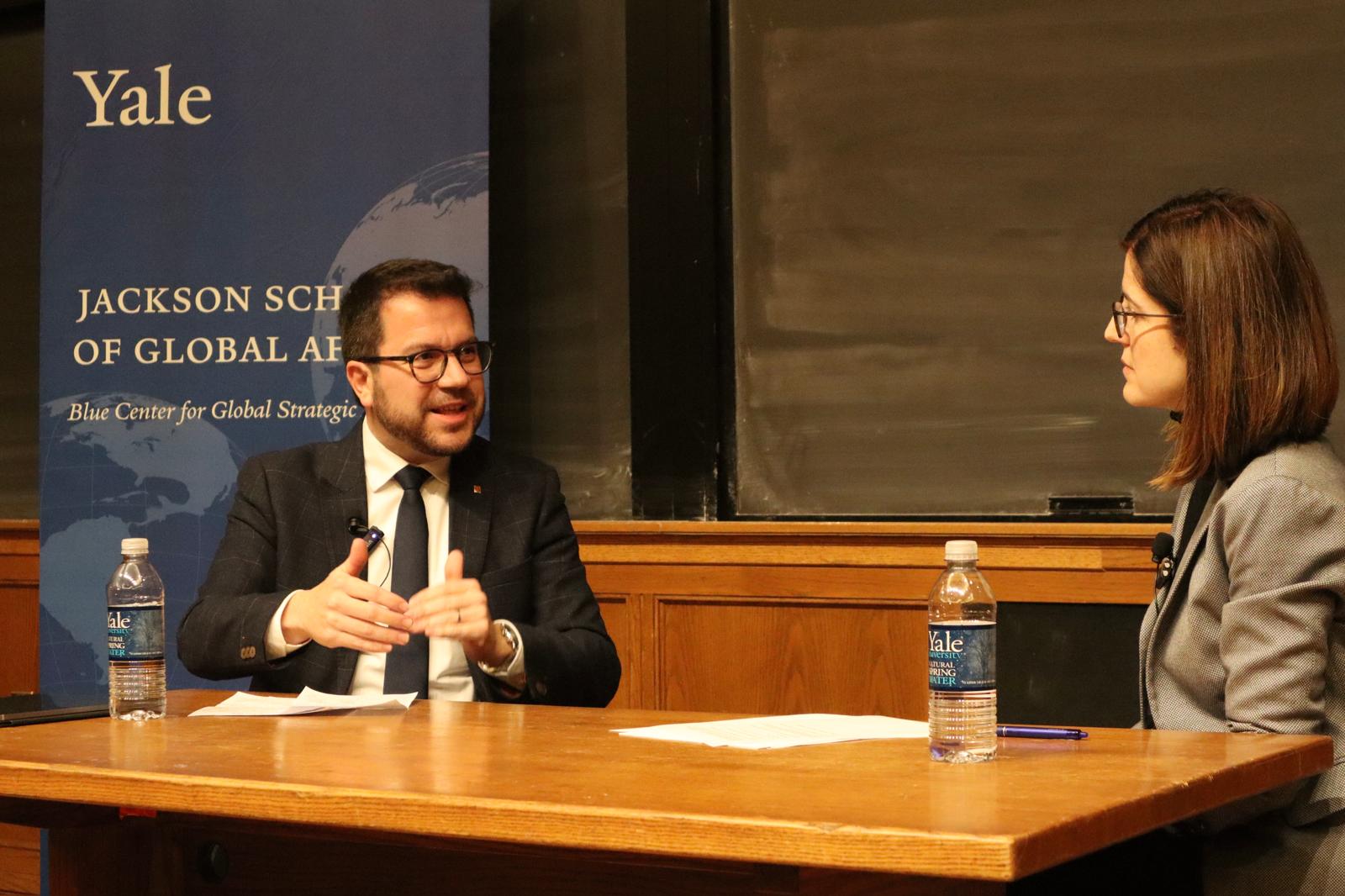
Excerpts from the address at Yale University
First, I want to state that this was not an isolated event in the history of Catalonia, nor is it a finished story. We have been negotiating for five years. So far, we have experienced the beginning of the negotiations, but there is still a long way to go to resolve the conflict. From my point of view, the unique solution to the conflict between Catalonia and Spain is a democratic vote about independence, a referendum on independence.
This process now depends on how negotiations continue. So far, we have experienced the beginning of the negotiation process. We achieved the agreements related to the end of repression. But the fundamental issue is still there, and it is not resolved: the will of the Catalan people to have a referendum on independence.
This is not an isolated event. The relationship between Catalonia and Spain is a long history of times of political tension and times of agreement, for centuries. Catalonia, as a nation, has expressed its will for self-government, to protect our language, to protect our culture, and to have the right to rule our society in order to promote prosperity, promote equality, and ultimately to reach a level of progress for all our citizens.
After the dictatorship in Spain, the process of decentralization was held. Catalonia recovered its autonomy with the return of the former president of Catalonia, who was in exile, Josep Tarradellas. It was the only recognition of an institution coming from the Republican regime that existed in Spain before the dictatorship.
For twenty years, the new decentralization process in Spain took place. But the result was a level of frustration because the goals of having strong autonomy were not achieved. In 2006, there was a proposal for the reform of autonomy, the Statute of Autonomy of Catalonia, that was agreed between the Catalan Parliament and the Spanish Parliament and was approved by the Catalan citizenship.
Four years later, in 2010, the Constitutional Court unilaterally changed that agreement, and this increased the sense of grievance among the Catalan population. There were several calls for dialogue from the Catalan government to the Spanish government. At the time, the Spanish government was led by the Conservative Party, the Popular Party. They rejected dialogue on autonomy.
As a result, the demands for independence grew significantly, and it became a cross-cutting movement. This was not only supported by parties like mine, the Republican Left, which has supported independence since the late 1980s, but also by other political parties.
The rejection of the Spanish government to enter into dialogue was, from my point of view, one of the reasons for the escalation of the conflict. I think they underestimated both the ability of the independence movement of Catalonia to mobilize many people and how determined we were to achieve a referendum. For me, the main responsibility lay with the Spanish government, which rejected entering a negotiation process. Now we are in a very different situation, and we have to acknowledge that.
I have supported independence throughout my entire life. Since I was a teenager, I was involved in the grassroots of the pro-independence movement, through the youth branch of my political party. For me, Catalonia becoming an independent state is the ultimate goal of my political commitment. It is not my second-best option.
Perhaps for a generation that lived close to the transition from dictatorship to democracy and believed in developing autonomy, independence became the second-best option in 2017. Being an independence supporter gave me the legitimacy to say: let’s engage in negotiation, think strategically, and take advantage of the political opportunities we had.
One of those opportunities arose after the Supreme Court sentence and the penalties of between nine and thirteen years of imprisonment imposed on political leaders and civil society leaders in Catalonia. At that moment, the Socialist Party in Spain needed our votes to appoint Pedro Sánchez as president.
When I started the conversations with him, now the Prime Minister of Spain, he said that we had to find a solution. I said that our proposal was to start a negotiation process, to establish a framework and initial measures. One of the first measures had to be ending repression against the pro-independence movement.
I was very clear: my ultimate goal is a referendum on independence in Catalonia. I know that this proposal is rejected by the Spanish government, but we can both commit to a negotiation process to solve the conflict. These were the basic foundations on which the negotiation process started.
If you find yourself in this situation, it is not easy, because you are trying to advance in a negotiation process. Sometimes, in a negotiation, reaching an agreement is difficult, but it is even more difficult to explain this agreement to your people. We had some people within some parties within the pro-independence movement who rejected the negotiation process.
Some of those who rejected the negotiation at that time are now in negotiation with the Spanish government, so that is a victory. Welcome, I say. But when you are entering into a negotiation and there are many attempts by some parts of the elite of the judiciary to derail this negotiation, this adds more complexity.
The fact that the oldest political party in Catalonia, the Republican Left, and the oldest pro-independence party, was leading this transition toward dialogue and negotiation was an asset. In other circumstances, it might have been much more difficult to make this shift and explain it to our people.
At that time, some of our leaders were imprisoned, others were in exile, and we were engaging in a very complex political negotiation with the Spanish government. But the historical legitimacy of our party allowed us to say to people: you can trust us. We are engaging in a negotiation that could allow us to achieve success. And we did achieve important successes: the release of political prisoners, the amnesty law, and, more recently, steps forward in restoring autonomy.
One key achievement was the recognition that political and legal repression against the independence movement in Catalonia was not an appropriate response by the state. To restore social cohesion, repression had to end. This was the foundation of the amnesty law.
During this negotiation period, we also achieved important international recognition. The Parliamentary Assembly of the Council of Europe approved a report calling on both sides to negotiate, asking the Spanish government to release political prisoners and facilitate the return of those in exile. It also encouraged dialogue on the political future of Catalonia.
Additionally, the United Nations Working Group on Arbitrary Detention issued a statement denouncing the situation of political prisoners. This was not an isolated measure but a necessary correction of an inadequate response by Spanish institutions to the pro-independence movement.
When we started the negotiation process, our first goal was to establish a negotiation framework. This framework was based on several principles. The first was the recognition of a political conflict. At the time, the Spanish government denied this, claiming there was no political conflict, only individuals breaking the law.
The second principle was the legitimacy of both sides to propose solutions. Independence and self-determination are legitimate political positions. The Spanish government rejects them but acknowledges them as legitimate political positions.
The third principle was that the conflict must be addressed through negotiation to achieve a democratic solution. The final principle was that any agreement must be approved by the Catalan citizenry in a vote. Which agreement that will be remains to be determined. My hope is that it will establish a legal framework to allow Catalonia to hold a referendum on independence.
In any negotiation, it is essential to be honest about your goals and to understand that the other side has limited room to move. Five years ago, if we had said “independence or nothing,” we would have achieved nothing.
Another key agreement with the Spanish government was that repression had to end. Political prisoners were released in June 2021. Later, the Spanish criminal law was reformed, and the crime of sedition was abolished because of its political bias. This prevented many people from facing prison or other penalties.
In May 2024, the amnesty law was approved. This process did not consist of a single step but of several steps over time. That is the nature of negotiation. You cannot expect to achieve your goals overnight.
At the same time, there were attempts by parts of the judiciary, the media, and conservative forces to derail the negotiations, adding further complexity. In my own case, I was illegally surveilled by the Spanish intelligence services during this period, a matter still under investigation by Spanish courts.
The Spanish government also faced pressure from the judiciary and sometimes used that pressure to slow down negotiations. All of this made the process more difficult.
If you look at all this process, looking at when we were and in which conditions we were five years ago, and which are the conditions we have now, it has been a great success. And I think that if you are in a position of leadership, if you are the president of your nation, you do not have to think about the next elections if there is a contradiction with thinking about the next generations.
So I assume the responsibility, a hard responsibility, of the electoral cost, because in a moment where all over the world polarization is everywhere, in Catalonia, in Spain, in the States, perhaps talking about agreement, negotiation, and dialogue is not very fashionable, but I think it is what is important and what is responsible through the lens of history.
Recognizing the political conflict remains essential. Every country and every nation has its own history and conditions; there is no universal blueprint. But negotiation, and the acceptance by the Spanish government that this is an issue they can discuss, is the best way to manage a conflict like this, especially in a democracy.
VERSIÓ EN CATALÀ
Fragments de la intervenció a la Universitat de Yale
Primer, vull afirmar que el procés de negociació no ha estat un esdeveniment aïllat en la història de Catalunya, ni tampoc és una història tancada. Fa cinc anys que estem negociant. Fins ara, hem viscut l’inici de les negociacions, però encara queda un llarg camí per recórrer per resoldre el conflicte. Des del meu punt de vista, l’única solució al conflicte entre Catalunya i Espanya és una votació democràtica sobre la independència, un referèndum d’independència.
Aquest procés depèn ara de com continuïn les negociacions. Fins ara, hem viscut l’inici del procés de negociació. Hem assolit acords relacionats amb la fi de la repressió. Però la qüestió fonamental encara hi és i no està resolta: la voluntat del poble català de tenir un referèndum sobre la independència.
Això no és un fet aïllat. La relació entre Catalunya i Espanya és una llarga història de períodes de tensió política i de períodes d’acord, al llarg de segles. Catalunya, com a nació, ha expressat la seva voluntat d’autogovern per protegir la nostra llengua, protegir la nostra cultura i tenir el dret de governar la nostra societat amb l’objectiu de promoure la prosperitat, promoure la igualtat i, en última instància, assolir un nivell de progrés per a tots els nostres ciutadans.
Després de la dictadura a Espanya, es va dur a terme un procés de descentralització. Catalunya va recuperar la seva autonomia amb el retorn del president de Catalunya, que era a l’exili, Josep Tarradellas. Va ser l’únic reconeixement d’una institució procedent del règim republicà que havia existit a Espanya abans de la dictadura.
Durant vint anys, aquest nou procés de descentralització a Espanya es va desenvolupar. Però el resultat va ser un nivell de frustració, perquè els objectius d’assolir una autonomia forta no es van aconseguir. L’any 2006 es va presentar una proposta de reforma de l’autonomia, l’Estatut d’Autonomia de Catalunya, que va ser acordada entre el Parlament de Catalunya i el Parlament espanyol i aprovada per la ciutadania catalana.
Quatre anys més tard, el 2010, el Tribunal Constitucional va modificar unilateralment aquell acord, i això va incrementar el sentiment de greuge entre la població catalana. Hi va haver diverses crides al diàleg des del govern català cap al govern espanyol. En aquell moment, el govern espanyol estava liderat pel partit conservador, el Partit Popular. Van rebutjar el diàleg sobre l’autonomia.
Com a resultat, les demandes d’independència van créixer de manera significativa i es van convertir en un moviment transversal. Aquest moviment no només va comptar amb el suport de partits com el meu, Esquerra Republicana, que dona suport a la independència des de finals dels anys vuitanta, sinó també d’altres partits polítics.
El rebuig del govern espanyol a entrar en un diàleg va ser, des del meu punt de vista, una de les causes de l’escalada del conflicte. Crec que van subestimar tant la capacitat del moviment independentista de Catalunya de mobilitzar molta gent com la determinació que teníem per aconseguir un referèndum. Per a mi, la responsabilitat principal va recaure en el govern espanyol, que va rebutjar iniciar un procés de negociació. Ara ens trobem en una situació molt diferent, i cal reconèixer-ho.
He donat suport a la independència al llarg de tota la meva vida. Des que era adolescent, vaig participar en les bases del moviment independentista, a través de la branca juvenil del meu partit polític. Per a mi, que Catalunya esdevingui un estat independent és l’objectiu últim del meu compromís polític. No és una opció de segona.
Potser per a una generació que va viure de prop la transició de la dictadura a la democràcia i que creia en el desenvolupament de l’autonomia, la independència es va convertir en una nova opció l’any 2017. El fet de ser un independentista convençut em va donar la legitimitat per dir: entrem en una negociació, pensem estratègicament i aprofitem les oportunitats polítiques que teníem.
Una d’aquestes oportunitats va sorgir després de la sentència del Tribunal Suprem i de les penes d’entre nou i tretze anys de presó imposades a líders polítics i a líders de la societat civil a Catalunya. En aquell moment, el Partit Socialista a Espanya necessitava els nostres vots per investir Pedro Sánchez com a president.
Quan vaig iniciar les converses amb ell, actualment president del govern espanyol, va dir que calia trobar una solució. Jo vaig respondre que la nostra proposta era iniciar un procés de negociació, establir un marc i unes primeres mesures. I una de les primeres mesures havia de ser posar fi a la repressió contra el moviment independentista.
Vaig ser molt clar: el meu objectiu últim és un referèndum d’independència a Catalunya. Sé que aquesta proposta és rebutjada pel govern espanyol, però tots dos podem comprometre’ns a un procés de negociació per resoldre el conflicte. Aquests van ser els fonaments bàsics sobre els quals es va iniciar el procés de negociació.
Si et trobes en aquesta situació, no és fàcil, perquè intentes avançar en un procés de negociació. De vegades, en una negociació, arribar a un acord és difícil, però encara ho és més explicar aquest acord a la teva gent. Hi va haver persones i partits dins del moviment independentista que van rebutjar el procés de negociació.
Alguns dels que el van rebutjar en aquell moment ara estan negociant amb el govern espanyol, i això és una victòria. Siguin benvinguts. Però quan entres en una negociació i hi ha molts intents, per part de sectors de l’elit judicial, de descarrilar-la, això afegeix més complexitat.
El fet que el partit polític més antic de Catalunya, Esquerra Republicana, i el partit independentista més antic, liderés aquesta transició cap al diàleg i la negociació va ser un actiu. En altres circumstàncies, hauria estat molt més difícil fer aquest gir i explicar-lo a la nostra gent.
En aquell moment, alguns dels nostres líders eren a la presó, d’altres eren a l’exili, i estàvem immersos en una negociació política molt complexa amb el govern espanyol. Però la legitimitat històrica del nostre partit ens va permetre dir a la gent: podeu confiar en nosaltres. Estem participant en una negociació que pot permetre’ns assolir èxits. I, de fet, vam aconseguir èxits importants: l’alliberament dels presos polítics, la llei d’amnistia i, més recentment, passos endavant en la recuperació de l’autonomia.
Un dels assoliments clau va ser el reconeixement que la repressió política i jurídica contra el moviment independentista a Catalunya no era una resposta adequada per part de l’Estat. Per restaurar la cohesió social, calia posar fi a la repressió. Aquest va ser el fonament de la llei d’amnistia.
Durant aquest període de negociacions, també vam obtenir un reconeixement internacional important. L’Assemblea Parlamentària del Consell d’Europa va aprovar un informe que instava totes dues parts a negociar, demanava al govern espanyol l’alliberament dels presos polítics i facilitava el retorn de les persones exiliades. També promovia el diàleg sobre el futur polític de Catalunya.
A més, el Grup de Treball de les Nacions Unides sobre Detencions Arbitràries va emetre una declaració denunciant la situació dels presos polítics. Això no va ser una mesura aïllada, sinó una correcció necessària d’una resposta inadequada de les institucions espanyoles davant del moviment independentista.
Quan vam iniciar el procés de negociació, el nostre primer objectiu va ser establir un marc de negociació. Aquest marc es basava en diversos principis. El primer era el reconeixement d’un conflicte polític. En aquell moment, el govern espanyol ho negava i afirmava que no hi havia cap conflicte polític, sinó persones que incomplien la llei.
El segon principi era la legitimitat de totes dues parts per proposar solucions. La independència i l’autodeterminació són posicions polítiques legítimes. El govern espanyol les rebutja, però les reconeix com a legítimes políticament.
El tercer principi era que el conflicte s’havia d’abordar mitjançant la negociació per assolir una solució democràtica. I el principi final era que qualsevol acord havia de ser aprovat per la ciutadania catalana mitjançant una votació. Quin acord? Encara està per determinar. La meva esperança és que estableixi un marc legal que permeti a Catalunya celebrar un referèndum d’independència.
En qualsevol negociació, és essencial ser honest sobre els propis objectius i entendre que l’altra part té un marge de maniobra limitat. Fa cinc anys, si haguéssim dit “independència o res”, no hauríem aconseguit res.
Un altre acord clau amb el govern espanyol va ser que la repressió havia d’acabar. Els presos polítics van ser alliberats el juny del 2021. Posteriorment, es va reformar el Codi Penal espanyol i es va abolir el delicte de sedició, pel seu biaix polític. Això va evitar que moltes persones afrontessin penes de presó o altres sancions.
El maig del 2024 es va aprovar la llei d’amnistia. Aquest procés no va consistir en un únic pas, sinó en diversos passos al llarg del temps. Aquesta és la naturalesa de la negociació: no es poden assolir els objectius d’un dia per l’altre.
Al mateix temps, hi va haver intents per part de sectors de la judicatura, dels mitjans de comunicació i de forces conservadores de descarrilar les negociacions, afegint-hi encara més complexitat. En el meu cas, vaig ser il·legalment espiat pels serveis d’intel·ligència espanyols durant aquest període, un fet que encara està sota investigació als tribunals espanyols.
El govern espanyol també va rebre pressions del poder judicial i, en alguns moments, va utilitzar aquestes pressions per alentir les negociacions. Tot plegat va fer el procés més difícil.
Si mirem tot aquest procés, observant on érem i en quines condicions érem fa cinc anys, i quines són les condicions actuals, ha estat un gran èxit. I crec que, si ets en una posició de lideratge, si ets el president de la teva nació, no has de pensar en les pròximes eleccions si això entra en contradicció amb pensar en les pròximes generacions.
Per això assumeixo la responsabilitat, una responsabilitat dura, del cost electoral, perquè en un moment en què arreu del món la polarització és omnipresent —a Catalunya, a Espanya i als Estats Units—, potser parlar d’acord, negociació i diàleg no és gaire de moda, però crec que és el que és important i el que és responsable des de la perspectiva de la història.
El reconeixement del conflicte polític continua sent essencial. Cada país i cada nació tenen la seva pròpia història i condicions; no hi ha cap model universal. Però la negociació, i l’acceptació per part del govern espanyol que aquest és un assumpte del qual es pot parlar, és la millor manera de gestionar un conflicte com aquest, especialment en una democràcia.