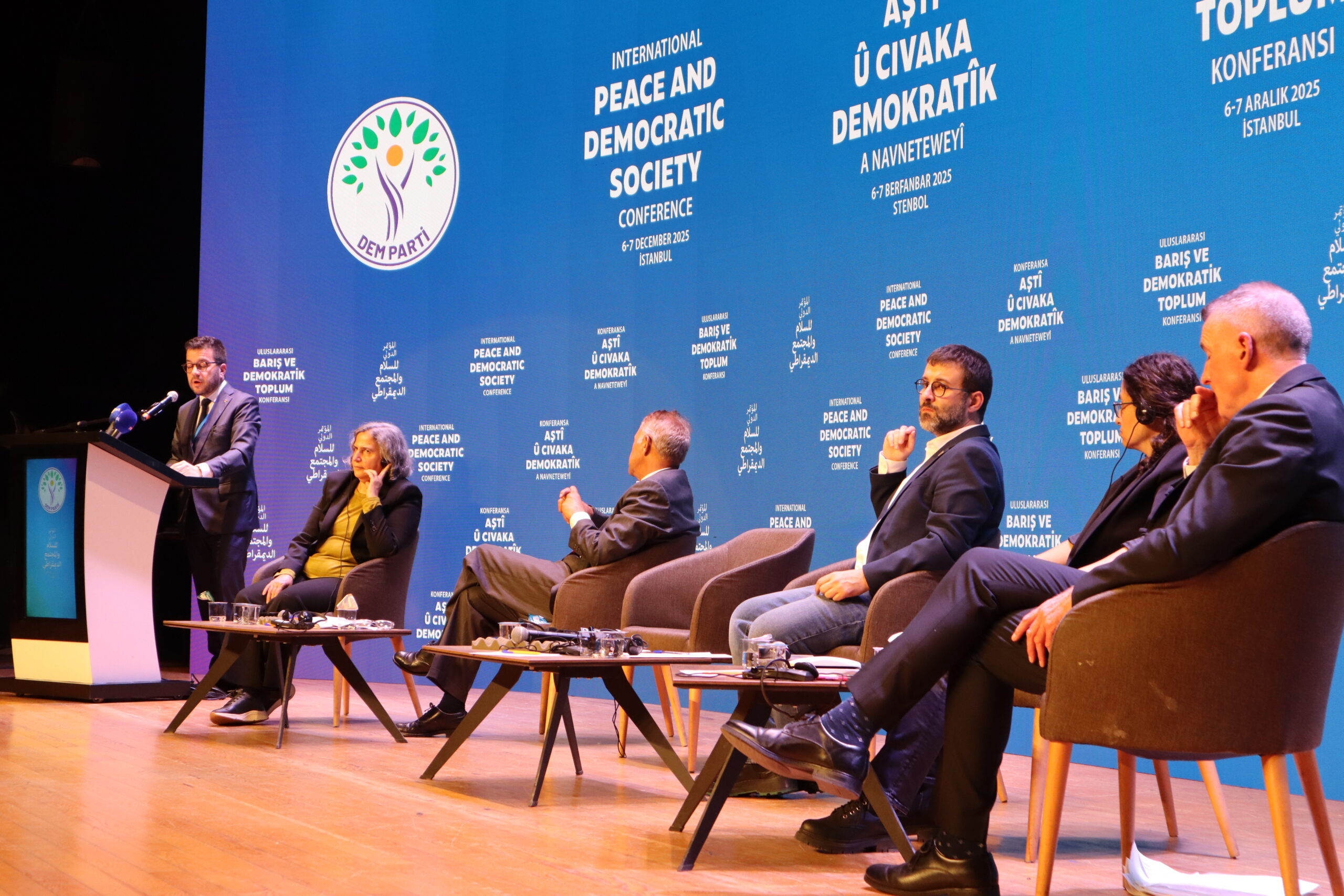
Bona tarda, distingits col·legues, copresidents, organitzadors, assistents, convidats, amics. Gràcies per convidar-me, com a expresident del govern de Catalunya, a aquesta conferència internacional i a explicar l’experiència del govern català i del moviment catalanista proindependència en la nostra negociació amb el govern espanyol.
Abans d’entrar en els detalls de la negociació, vull expressar, com a expresident de Catalunya i en nom de totes les persones del nostre país que donen suport a la independència, el nostre suport al poble kurd en la seva lluita per la pau, la justícia, la llibertat i l’equitat. Tant Catalunya com el Kurdistan, igual que altres nacions, ens trobem en una situació similar. Som nacions oprimides en el nostre camí cap a la llibertat i la sobirania plena. Per això som amb vosaltres. La vostra lluita és la nostra lluita.
Abans d’entrar en detall, vull subratllar el fet que Catalunya ha fet progressos significatius gràcies a la negociació i al diàleg els darrers anys. Pas a pas, sovint lentament, de vegades contra una resistència forta, hem demostrat que el coratge polític i els mètodes democràtics poden obrir portes que semblaven definitivament tancades. Però encara ens queda un pas decisiu: resoldre el conflicte polític de fons. Fins i tot el president del govern espanyol, Pedro Sánchez, ha reconegut públicament, tant durant les negociacions com encara avui, que el conflicte polític subjacent continua sense resoldre i que només es pot solucionar per vies democràtiques, permetent que el poble de Catalunya voti i decideixi el seu futur.
Abans d’explicar en detall el procés polític —el procés de negociació entre el govern català i el govern espanyol— unes paraules sobre els orígens del conflicte entre Catalunya i Espanya.
Catalunya és una nació amb una llarga història de lluita per la nostra llibertat, la nostra identitat i la nostra llengua. Durant els darrers segles, la major part del temps hem estat sota l’opressió de dictadures del govern espanyol. Des del final de la dictadura franquista, als anys setanta del segle passat, Catalunya va recuperar l’autonomia. Però els problemes associats al procés de descentralització, insuficient i desequilibrat, van portar a una reforma del nostre Estatut d’Autonomia. Aquest procés va acabar amb un acord amb el Parlament espanyol —un acord que va ser modificat unilateralment pel Tribunal Constitucional, esbiaixat per una visió ultranacionalista i dretana sobre com s’havia de configurar Espanya. Això va generar una crisi constitucional, una escalada de posicions que va culminar el 2017 amb el referèndum d’independència.
Aquest referèndum va ser aprovat pel Parlament de Catalunya i organitzat pel govern català. La reacció del govern espanyol i de la policia espanyola va ser, primer, la suspensió de l’autonomia de Catalunya i, segon, l’inici d’una repressió contra el lideratge, els activistes i la ciutadania compromesa amb la independència. El nostre govern d’aquell moment va acabar, o bé empresonat, o bé forçat a l’exili. La presidenta del Parlament, Carme Forcadell, va ser empresonada. Els líders de les principals organitzacions civiques també. Es van obrir multitud de procediments judicials contra alcaldes, activistes i servidors públics, només per la seva tasca durant el referèndum.
El 2019, el Tribunal Suprem espanyol va dictar sentència condemnant els líders independentistes a un total d’un segle de presó acumulat, amb màxims de 13 anys per als líders més destacats. Després d’això, a Catalunya hi va haver grans mobilitzacions, nous enfrontaments amb la policia. Però, en aquell moment de crisi, va aparèixer una oportunitat. De vegades les oportunitats arriben quan no estàs en les millors condicions per gestionar-les, però arriben: eleccions generals a Espanya.
El Partit Socialista necessitava els vots d’Esquerra Republicana —el partit independentista d’esquerres de Catalunya. Necessitaven els nostres vots. I els vam oferir a canvi d’un procés de negociació cap a una solució política. Així, el novembre del 2019 vam iniciar converses informals amb el govern espanyol. Recordo perfectament la meva conversa amb Pedro Sánchez, el president del govern espanyol, en una reunió no pública el desembre de 2019. Li vaig dir: jo defenso l’autodeterminació de Catalunya. Jo defenso la independència plena de Catalunya. I sé que vostè rebutja aquesta posició. Però sé que vol una solució política. No sabem quina serà la solució al final del procés, però tenim l’oportunitat d’iniciar un procés de negociació per trobar una solució política i democràtica al conflicte entre el poble català i l’Estat espanyol.
Un mes després, es va establir un acord entre Esquerra Republicana —el partit independentista d’esquerres— i el Partit Socialista, que avui governa Espanya. Aquest acord reconeixia, primer, l’existència d’un conflicte polític. Segon, que cal una negociació per resoldre’l. I tercer —un pas molt important— que la solució definitiva s’hauria d’assolir mitjançant una votació del poble de Catalunya. Trobar les paraules adequades perquè totes dues parts se sentissin còmodes era essencial. La nostra proposta era un referèndum d’autodeterminació. Ells la rebutjaven. Però sabien que, probablement, una votació seria necessària. No teníem un acord, però teníem un marc democràtic.
Des de llavors vam iniciar el procés de negociació. Des del principi afrontàvem un dilema entre l’oportunitat d’avançar amb la negociació amb els nostres adversaris —el govern espanyol— per arribar a una solució política i superar el patiment de la nostra gent, i el risc de ser utilitzats pel govern espanyol només per obtenir els nostres vots i, després, oblidar-se de la solució política. Equilibrar això era —i és— molt difícil.
Com ho vam resoldre? Mirant l’alternativa. L’alternativa, quan es negociava la formació del govern espanyol, eren unes noves eleccions i la possibilitat d’un govern format pel Partit Popular i Vox, la dreta i l’extrema dreta espanyola. Així doncs, vam resoldre el dilema i vam iniciar el procés de negociació.
El febrer de 2020 va tenir lloc la primera reunió de la taula de diàleg —una reunió pública. Era important per a nosaltres que fos pública, perquè implicava el reconeixement del govern de Catalunya com a actor legítim defensant els drets i els interessos dels catalans. Vam defensar sempre que els actors a la taula havien de ser el govern català i el govern espanyol. Hi havia canals discrets, sí, però la publicitat d’aquella reunió era un pas clau.
En aquella primera reunió, per primer cop, el govern català va demanar oficialment al president del govern espanyol, en un acte públic, un referèndum d’autodeterminació, l’amnistia per als presos polítics i la fi de la repressió.
Després d’aquella reunió vam continuar treballant, però va arribar un bloqueig per la pandèmia i per les eleccions catalanes. En aquelles eleccions el lideratge del costat català va canviar. Jo vaig ser elegit president i el meu compromís amb el procés de negociació era absolut. I això va ser un pas endavant per generar confiança entre les parts.
Des del maig-juny del 2021 vam reprendre la taula de negociació. Vam continuar i vam assolir diversos acords: l’alliberament dels presos polítics; la reforma del Codi Penal espanyol; la supressió del delicte de sedició, acordada políticament i aprovada pel Parlament espanyol. Aquest delicte —pel qual havien estat condemnats els nostres companys el 2019— ja no existeix, i no podrà tornar-se a aplicar a ningú que reclami independència o un canvi constitucional.
Vam aconseguir altres acords: mesures de protecció de la llengua catalana com a via per generar confiança entre les parts. Ara el català es pot parlar al Parlament espanyol —un pas simbòlic molt important per al reconeixement del pluralisme lingüístic i nacional. I actualment la possibilitat que el català esdevingui llengua oficial de la Unió Europea està sent discutida a les institucions europees, a proposta del govern espanyol. En molts sentits, doncs, hi ha hagut avenços importants.
Finalment, el maig de 2024 vam aprovar la Llei d’Amnistia per posar fi definitivament a la repressió. He de reconèixer que encara no s’ha aplicat completament. Encara afecta la llibertat de l’expresident Carles Puigdemont i la possibilitat que el líder d’Esquerra Republicana, Oriol Junqueras, pugui exercir plenament com a actor polític. Junqueras continua inhabilitat, i superar aquesta situació forma part de l’amnistia. Encara estem esperant. Recentment hem tingut el suport del Tribunal Constitucional, així que hi ha passos endavant. Però he de subratllar el que he dit al principi: el nucli del conflicte —la voluntat del poble català de decidir el seu futur i el rebuig de l’Estat espanyol— encara no està resolt. Ens queda un llarg camí per recórrer.
I ara, cinc reflexions finals —lliçons apreses del nostre procés de negociació.
Primera: cal una visió a llarg termini. Aquest és un conflicte amb arrels de segles. No es pot resoldre d’un dia per l’altre, ni en 24 hores, ni en una setmana, ni en un any. Necessita temps. I el temps en política vol dir compromís.
Segona: el nostre procés no ha estat lineal. Hem fet dos passos endavant i després tres enrere. Hem patit boicots, alguns procedents del mateix estat espanyol. Per exemple, vam descobrir que els membres del govern espanyol que participaven en la negociació ens tenien sota vigilància a través dels serveis d’intel·ligència. Ara, l’exdirector d’aquests serveis està processat en un jutjat de Barcelona. El procés, doncs, és no lineal. De vegades sembla que perds terreny, però és important mantenir l’estratègia.
Tercera: la importància de trobar les paraules adequades. La narrativa és crucial. Ningú en una negociació vol aparèixer com el perdedor. Això és cert per a la part feble —en aquest cas, la catalana— però també per a la part aparentment forta, l’Estat espanyol. Si la narrativa humilia l’altra banda, no hi ha avenç possible. Així que ens vam convertir en experts a trobar paraules que permetessin avançar. Per exemple, en la reforma del Codi Penal i l’eliminació de la sedició, el govern espanyol no volia una narrativa que suggerís que corregia la justícia. Per això, per a ells, “fi de la repressió” era massa fort. Vam trobar el concepte de “desjudicialització”: treure el conflicte de les mans dels tribunals i retornar-lo al terreny polític.
Nosaltres defensem un referèndum d’independència. Ells saben que això s’ha de resoldre amb algun tipus de votació. Però si jo exigia que acceptessin ara mateix un referèndum d’autodeterminació, no hi hauria hagut avenç. Per això vam trobar la idea de “la votació”—una votació popular a Catalunya sobre la solució.
Quarta: sempre hi haurà “spoilers” i “hardliners”. O, més ben dit, comportaments que fan aquesta funció. Tothom, fins i tot qui sembla més dur en un moment determinat, ha de poder ser inclòs en la negociació. Evitar comportaments que bloquegin l’avenç és essencial i, sovint, molt difícil. I com va dir un dels meus companys abans: la negociació més important és amb la teva pròpia gent. Després de pactar un acord, has de tornar al teu electorat i dir: “Això és el que hem aconseguit.” Has de preparar la gent perquè entengui que aquest és un camí gradual.
Cinquena: lideratge i inclusió. El lideratge és molt, molt important, perquè les oportunitats a vegades duren molt poc. Nosaltres vam tenir l’oportunitat perquè el govern espanyol necessitava els nostres vots al Parlament, i la vam aprofitar. Reconec que ells van començar el procés per interès polític. Però el que importa no són els motius, sinó els resultats. I el resultat és que avui tenim una Llei d’Amnistia.
El lideratge, doncs, és essencial. Quan, fa uns mesos, vaig veure el missatge del vostre líder Abdullah Öcalan, hi vaig veure un signe de lideratge. Canviar la història del vostre poble —del patiment a l’esperança de pau— requereix lideratge, assumir riscos, però lideratge al cap i a la fi.
I inclusió. Al final, el que volem amb aquest procés polític és vides millors per a la nostra gent, per a les nostres societats: una Catalunya més igualitària, més lliure; una Irlanda unida i pròspera; i un Kurdistan lliure, igual, democràtic i reconegut. Aquest és l’objectiu final, i per aconseguir-lo cal ser inclusiu.
Moltes gràcies. Moltes gràcies de tot cor, i tot el suport de Catalunya. Serem dues nacions lliures en el futur. Gràcies.
ENGLISH VERSION
Good afternoon, distinguished colleagues, co-chairs, organisers, attendees, guests and friends. I would like to thank you for inviting me, as the former President of the Government of Catalonia, to this international conference to discuss the experience of the Catalan government and the Catalan pro-independence movement in our negotiations with the Spanish government.
Before I discuss the details of the negotiations, I would like to express my support, and that of all Catalans who support independence for our country, for the Kurdish people in their struggle for peace, justice, freedom and equality. Catalonia and Kurdistan, like many other nations, are in the same position. We are oppressed nations on the path to freedom and full sovereignty. So we are with you. Your struggle is our struggle.
Before I go into more detail, I would like to emphasise that Catalonia has made significant progress through negotiation and dialogue in recent years. Step by step, and often slowly, we have demonstrated that political courage and democratic methods can open doors that once seemed permanently closed, even when faced with strong resistance. However, one decisive step remains: resolving the core political conflict. Spain’s Prime Minister, Pedro Sánchez, has publicly recognised this, both during the negotiations and still today. He acknowledges that the underlying political conflict remains unresolved and that it can only be settled through democratic means: by allowing the people of Catalonia to vote on their future.
Before explaining the political process in detail — the negotiations between the Catalan and Spanish governments — I will say a few words about the origins of the conflict between Catalonia and Spain.
Catalonia is a nation with a long history of fighting for freedom, identity and language. For most of the last few centuries, we have been oppressed by the Spanish state under dictatorial regimes. Since the end of Franco’s dictatorship in Spain in the 1970s, Catalonia has regained autonomy. However, problems associated with the inadequate decentralisation process led to a reform of our Statute of Autonomy. This process culminated in an agreement with the Spanish parliament, but this was unilaterally changed by the Constitutional Court, which was biased in favour of a right-wing, ultranationalist view of how Spain should be configured. This resulted in a constitutional crisis and an escalation of positions, culminating in the 2017 independence referendum.
The Catalan Parliament approved this referendum and the Catalan government organised it. In response, the Spanish government and police first suspended Catalonia’s autonomy and then began to repress the independence movement, targeting leaders, activists and ordinary people. At that time, our government was either imprisoned or forced into exile. Carme Forcadell, the Speaker of our Parliament, was imprisoned. Leaders of civic society organisations were also jailed. Many judicial proceedings were initiated against mayors, activists and public officials for their work during the time of the referendum.
In 2019, the Supreme Court of Spain issued a ruling condemning the leaders to a total of around one hundred years’ imprisonment, with the most prominent leaders receiving a maximum of thirteen years. Following this, Catalonia saw large-scale demonstrations and renewed clashes with the police. However, at that time, amid the crisis, an opportunity arose. Sometimes opportunities arise when you are not in the best position to take advantage of them, but this one did: general elections in Spain.
The Socialist Party needed votes from Esquerra Republicana, the progressive pro-independence party in Catalonia. They needed our votes. In exchange, we offered them a process of negotiation towards a political solution. In November 2019, we therefore started informal conversations with the Spanish government. I clearly remember my conversation with Pedro Sánchez, the Spanish Prime Minister, during a private meeting in December 2019. I said to him: ‘I defend the self-determination of Catalonia. I support full independence for Catalonia. I know that you reject that position. But I also know that you want a political solution. We don’t know what the final solution will be, but we have the opportunity to start negotiating a democratic political solution to the conflict between the Catalan people and the Spanish state.
One month later, an agreement between Esquerra Republicana and the Socialist Party, the party that currently rules the Spanish government, was set up. This agreement first recognized the existence of a political conflict. Second, it recognized that negotiation is needed to solve this conflict. And third — what I think is a very important step forward — that the ultimate solution will be reached through a vote by the Catalan people. Finding the correct words, with which both parties can feel comfortable, is very important. Our proposal was a referendum on self-determination. They rejected that position, but they had in mind that perhaps having a vote could be a solution. We did not have an agreement, but we had a democratic framework.
Since then, we started the negotiation process with this agreement. From the beginning, we were facing a dilemma between the opportunity to advance in a negotiation process with our opponents — the Spanish government — to reach a political solution and to overcome the suffering of our people, and the need to avoid being used by the Spanish government only to get our votes and then forget about the political solution. Balancing this was, and still is, very difficult.
How did we solve that dilemma? By looking at the alternative. At that time, the alternative — when a new Spanish government was being negotiated — was new elections and the possibility of a government formed by the Popular Party, the right-wing party, and Vox, the far-right ultranationalist Spanish party. So we solved this dilemma and started the negotiation process.
The first meeting of the negotiation table took place in February 2020 — it was a public meeting. It was important to us that this meeting be public, as this implied the recognition of the Catalan government as a legitimate representative of the citizens of Catalonia and their rights and interests. Throughout the entire process, we argued that the parties involved should be the Catalan government, representing the citizens of Catalonia, and the Spanish government. Backchannels operated by people from different parties enabled the process to advance.
However, this first meeting marked the first time that the Catalan government officially requested a referendum on self-determination, the release of political prisoners, and an end to the repression of pro-independence activists from the Spanish government in a public meeting.
After that meeting, we continued working, but then a deadlock occurred due to the pandemic, which was a significant obstacle, as well as due to Catalan elections. In those elections, the leadership in Catalonia changed. I was elected president after the elections and was absolutely committed to this negotiation process. This also helped to build trust between the two parties involved.
Since May–June 2021, we have been back at the negotiating table. We made progress and reached some agreements, including the release of political prisoners, the reform of Spain’s criminal code, and the abolition of the crime of sedition — for which our comrades were condemned in 2019 — through an agreement approved by the Spanish Parliament. This crime no longer exists in Spanish law and cannot be applied to anyone seeking political independence or constitutional change.
We also reached other agreements, including measures to protect the Catalan language, which will help to build confidence between the two sides. Catalan can now be spoken in the Spanish parliament, which is a significant symbolic step towards linguistic and national pluralism within the Spanish state. The use of Catalan as an official language of the European Union is also now being discussed in European institutions, following a proposal by the Spanish government. So, in many ways, important progress has been made.
Finally, in May 2024, we approved the Amnesty Law to end repression completely. However, I must acknowledge that this law has not yet been fully enforced. It still affects the freedom of the former President of Catalonia, Carles Puigdemont, and prevents the leader of Esquerra Republicana, Oriol Junqueras, from fully participating in politics. Junqueras is still disqualified from office, and resolving this situation is part of the amnesty law. We are still waiting. However, we recently received support from the Constitutional Court, so there have been some steps forward. However, I must reiterate what I said at the beginning: the root of the political conflict — the Catalan people’s desire to determine their own future and their rejection of the Spanish state — remains unresolved. We still have a long way to go to find a political solution.
Now, I would like to share five final thoughts — lessons learned from our negotiation process.
Firstly, we need a long-term vision. This is a long road; the conflict is rooted in centuries of history. It cannot be solved overnight, or in a week, or even in a year. We need time, and in politics, time means commitment.
Secondly, our process was non-linear. We took two steps forward and then three steps back. We suffered many boycotts, including some from Spanish state bodies. For example, members of the Spanish government who participated in the negotiations discovered that we were under surveillance by Spain’s intelligence agency. This came as no surprise, but we found out about it — and now the former director of the intelligence agency is on trial in Barcelona. So yes, the process is non-linear. Sometimes you feel that you are losing ground, but it is important to maintain your strategy.
Thirdly, it is important to find the right words. Narrative is very important. In a negotiation, no one wants to appear to be the loser. This applies to the weaker side — as in our case — as well as to the side in the apparently stronger position, the Spanish state. If the narrative aims to humiliate the other side, the negotiation cannot progress. So, we became experts in finding words to describe our progress. For instance, when we reached an agreement to reform the criminal code and suppress sedition, the Spanish government did not want to imply that they were correcting the judiciary. For them, ‘end of repression’ was too strong. So, we came up with the term ‘de-judicialisation’: taking the political conflict out of the judiciary and putting it back into the political arena.
We are defending the right to hold a referendum on independence. They know it will have to end in a vote of some kind. But if I say: ‘You must now accept a referendum on self-determination’, the negotiations cannot advance. So we came up with the idea of a popular vote in Catalonia on the solution. Finding words that give both sides room to manoeuvre is crucial.
Fourthly, you will encounter many spoilers and hardliners, or behaviours that act as such. Everyone in a movement, even those seen as hardliners, must be included in the negotiations. Avoiding behaviours that hinder the political process is crucial and can be very challenging. As one colleague said earlier, the most important negotiations are with your own people, not the other side. After drafting an agreement, you must return to your constituency and say: ‘We have achieved this.’ You must prepare people for a gradual process. That has been my experience.
Fifthly, leadership and inclusion are important. Leadership is extremely important because opportunities can be very short-lived. We had the opportunity to start the negotiation process because the Spanish government — the Socialist Party — needed votes in Parliament. I acknowledge that they started the negotiation process because of their political interests, but what matters are the results, not the motives. The result is that we now have an Amnesty Law.
And inclusion. Ultimately, our goal is to improve the lives of our people and societies: to create a more equal and free Catalonia, a united and prosperous Ireland, and a free, equal, democratic and recognised Kurdistan. This is the ultimate goal, and to achieve it, you must be inclusive.
Thank you. Thank you so much for all your support from Catalonia. In the future, we will be two free nations. Thank you.